

A New Rail Line "The Interborough Express" Aims to Unite Brooklyn and Queens

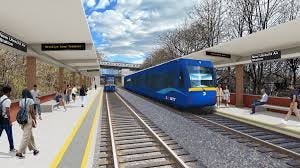
New York City is moving ahead with plans for its first entirely new transit line in decades: the Interborough Express, a 14-mile light rail route through Brooklyn and Queens that could dramatically reshape commuting patterns, and neighborhoods-across the two boroughs.
The $5.5 billion project, known as the IBX, is designed to run on an existing freight rail corridor and will connect 19 stations between the Brooklyn Army Terminal near the New York Harbor Ferry and Jackson Heights in Queens, a major hub for buses to La Guardia Airport. Along the route, the IBX will intersect with 17 subway lines, 51 bus routes, and a Long Island Rail Road station.
For New Yorkers who live in neighborhoods far from current subway lines or who must travel laterally across the city, the IBX promises to cut trip times dramatically by allowing them to bypass Manhattan altogether.
“It’s an exceptionally good project in terms of how many people it will serve and how effective it will be at reducing commute times and giving people a faster ride,” said Kate Slevin, executive vice president of the Regional Plan Association, an urban planning organization that has advocated for this transit line for decades.
The IBX route, which will use light rail trains running parallel to freight service, has roots in the Regional Plan Association’s 1996 proposal for the “Triboro Express,” a rail line connecting Brooklyn, Queens, and the Bronx via existing freight corridors. While the Bronx segment was later dropped in favor of other rail services, political momentum grew in 2019 after New York State passed legislation for congestion pricing in Manhattan, with revenue intended to fund transit upgrades, including the IBX.
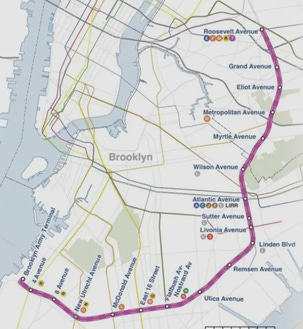
Since taking office in 2021, Governor Kathy Hochul has championed the IBX as a high priority for the Metropolitan Transportation Authority. In early 2025, after delays, Hochul initiated congestion pricing, which provided a crucial funding source for the MTA’s current capital plan. In October 2025, the MTA launched its 18-month environmental review for the IBX, alongside a two-year design process. Construction could begin before the decade’s end, with service starting in the 2030s.
Despite broad institutional support, the IBX faces scrutiny and resistance on multiple fronts. Transit advocates are calling for technical improvements, including automatic train operation and higher service frequency. Meanwhile, residents and elected officials in some neighborhoods worry the project could spur unwanted development.
“The amount of people it’s going to bring into the neighborhood,” said Dorothy Werkmeister, a Middle Village resident, when asked about her concerns.
That sentiment was echoed at a community meeting in Middle Village, where discussion of the tunnel under All Faiths Cemetery turned into arguments over neighborhood change, noise, and development. Local elected officials, including outgoing councilmember Bob Holden and his successor Phil Wong, have also linked the IBX to potential increases in housing density.
The tension reflects a broader divide in New York City politics between transit-oriented urbanism and suburban-style status quo. The IBX corridor passes through areas that combine industrial zones, low-density single-family housing, and emerging hubs of growth. According to the New York Building Congress, about 50% of the land within half a mile of the planned stations is currently zoned for low-density residential use, while 30% is zoned for high-density housing and 20% for industrial use.
A report by the Building Congress recommends rezoning the low-density areas along the corridor to allow for approximately 83,000 new housing units, comparable to the density of Brownstone Brooklyn.
“It’s not turning the area into the Upper East Side—it’s a little more housing,” said Carlo Casa, policy and research director at the organization.
Transit experts argue that increasing housing is essential to justify the investment in high-capacity transit.
“It doesn’t make sense to build high-capacity transit, at high costs, and then be like, we’re not going to derive any other types of benefits other than for the people that already live there,” said Eric Goldwyn, director of the Transit Costs Project at NYU.
In January 2023, the MTA chose light rail technology for the IBX, citing advantages such as faster acceleration and smaller train sizes compared to traditional subway stock. The current plan includes a dedicated freight track to accommodate existing rail services, including the so-called “pizza and beer train” that delivers goods to Long Island. A jet fuel pipeline that runs along much of the corridor may also need to be relocated.
In an early cost-saving measure, the MTA proposed routing trains along the street to bypass a corner of All Faiths Cemetery. But after advocacy from the Effective Transit Alliance, which argued that doing so would slow the line and constrain ridership, the MTA opted to tunnel beneath the cemetery instead. Travel time estimates for the full route dropped from 39 minutes to 32 minutes, raising projected daily ridership from 110,000 to 160,000. At a recent event, MTA Chairman Janno Lieber projected “a 30-minute ride end to end” and “over 200,000” daily riders, though an MTA spokesperson later clarified the original projections remain in effect.
“The MTA is listening to advocates and taking both community feedback and internal analysis into account,” said Jordan Smith, a planner on the project. He specifically cited changes to the Broadway Junction station location and updated plans to tunnel under All Faiths Cemetery. “We’re looking at both the community’s feedback and also what makes a better project.”
Advocates such as Blair Lorenzo, executive director of the Effective Transit Alliance, remain focused on pushing for a fully automated “light metro” system like the JFK AirTrain, allowing service to run every 90 seconds. The MTA has not yet decided whether the IBX will use automation. “Nothing we’ve done would preclude that,” Smith said. “But we haven’t made any decisions yet.”
Automation could be hindered by legislation awaiting Governor Hochul’s signature that would require two-person crews on all MTA train operations, a measure supported by transit labor unions.
Another vital issue is the quality of connections to existing lines. For example, reaching the Roosevelt Avenue subway station in Jackson Heights from the IBX may require transferring via surface streets, unless infrastructure like pedestrian bridges or moving walkways is built. The MTA has already revised several station plans in response to such concerns, including improving proximity to other lines at Broadway Junction.
Beyond transit, the IBX raises questions about land use and economic value. Stijn van Nieuwerburgh, a professor at Columbia Business School, co-authored a study showing that nearby real estate values surged after the Second Avenue subway opened in Manhattan. That study found the public only recouped a fraction of the value increase through general property taxes and recommends adopting “value capture” strategies to channel part of the private benefit toward public infrastructure.
“Look, your property is worth X today. After this infrastructure, it will be worth X plus $50,000. We need $10,000 of that $50,000 extra value creation,” van Nieuwerburgh said.
So far, just half of the IBX’s projected $5.5 billion price tag has confirmed funding.
“It’s crucial to make these types of investments as a city,” van Nieuwerburgh said. “But we’ve got to pay for it.”
As construction timelines stretch years into the future, much about the IBX remains uncertain. But if completed, the line would significantly change how people travel through Brooklyn and Queens, particularly in areas like Middle Village, where today’s big-box stores and commuter parking lots could soon sit next to a busy new transit station.