

Hochul and Mamdani Launch Free Child Care for Two-Year-Olds with "2-Care" Initiative

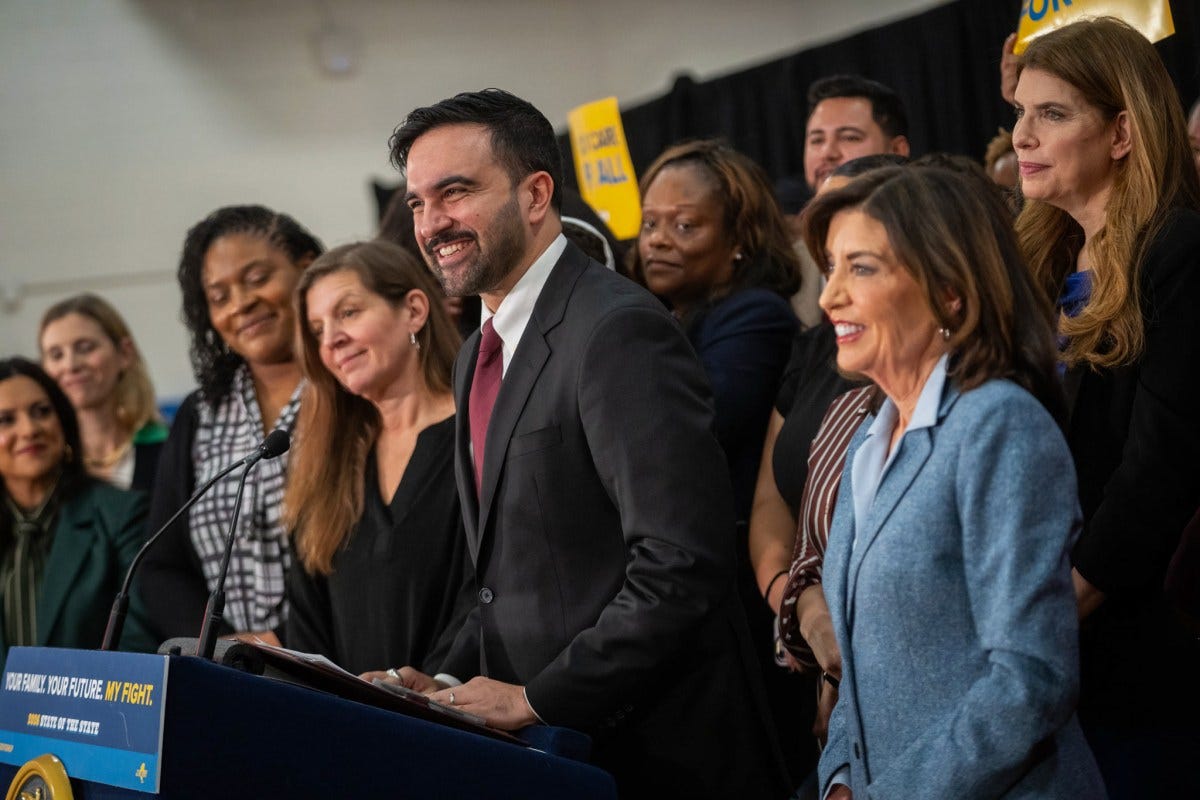
Governor Kathy Hochul and New York City Mayor Zohran Mamdani announced a new initiative Thursday that will offer free child care to 2-year-olds across the city, marking a significant expansion in early childhood services as part of a two-year state-funded trial.
Speaking at a YMCA in Flatbush, Brooklyn, Hochul unveiled the plan, dubbed “2-Care,” which will begin in fall 2026. The program is slated to start in neighborhoods identified as high need, with the goal of reaching full citywide availability by the fourth year.
“The cost of child care is too damn high,” Hochul said. “We know this is a determinative factor of whether or not a family who wants to stay in New York or come to New York can pull it all off and make it work.”
The initiative delivers on a central campaign promise by Mamdani, who advocated for universal child care during his mayoral bid. Standing beside Hochul at the event, Mamdani called the launch of 2-Care a major step toward achieving a more affordable New York City.
“Today we take one step to realizing a city where every New Yorker, every family, every child can afford to keep calling it their own,” Mamdani said.
The first year of the program, covering the 2026-2027 school year, is expected to serve about 2,000 children at a cost of approximately $75 million, according to Mamdani. In its second year, the program is projected to cost around $425 million as it scales to serve more families.
Cara, a mother of two in Bedford-Stuyvesant, Brooklyn, said the announcement gave her hope that her family might be able to grow without facing crushing financial burdens.
“It feels daunting, the idea of can we afford another? But if a massive cost is lifted, maybe we can,” she said. “I owe my second kid to de Blasio. I might owe my third to Mamdani.”
Cara, who works in maternal health, delayed having her second child due to the overwhelming expense of child care. Her eldest child, now four, attends free pre-K—a program launched by former Mayor Bill de Blasio—and was previously enrolled in a 3-K program. She currently pays about $2,500 per month for care for her 16-month-old.
Child care expenses remain one of the most pressing issues for New York City families, with some paying upwards of $20,000 annually, rivaling housing costs. Research shows that families with children under the age of six are twice as likely to leave the city compared to those without young children.
In tandem with launching 2-Care, Hochul also pledged $100 million to bolster the city's existing 3-K program. Mamdani said that funding will go toward increasing seat availability in neighborhoods where demand has not yet been met.
The governor further committed to making free pre-K available statewide for 4-year-olds by the 2028 school year. As part of a broader investment in child care, Hochul announced an additional $1.2 billion for subsidies to assist low-income families, bringing total state support for subsidies to $3 billion. These subsidies allow qualifying families to pay about $15 per week for child care services.
However, at the time of the announcement, New York City had a voucher waitlist numbering at least 10,000 families, with no capacity to add new applicants. Hochul said she did not know whether the new funds would be sufficient to reopen the waitlist or resolve the existing backlog.
Questions about long-term funding continue to loom over the initiative. Hochul said the state is committed to supporting the 2-Care program beyond the initial two years but acknowledged uncertainties surrounding future budgets.
“For me to project three and four years down the road is asking quite a bit, but we’re committed to making this fully universal for the entire state,” she said.
The Fiscal Policy Institute has estimated that implementing a fully universal 2-Care program in New York City could cost about $1 billion annually. The institute has proposed new taxation strategies to fund the initiative.
Mamdani and other progressive advocates have pushed for raising taxes on high earners to support child care expansion. However, Hochul’s current plan relies on repurposing existing revenue streams rather than introducing new taxes.
Critics have raised concerns about the financial risks involved in the short-term funding model.
“A two-year funding plan creates a fiscal cliff, a risk for both the state budget and the program,” said Andrew Rein, president of the Citizens Budget Commission. “The state should fund this sustainably, within its existing budget plan, to ensure that New Yorkers in need have reliable access into the future. That means making smart, hard choices, shifting money from less-effective programs to deliver on this priority.”
Further complicating the financial outlook is the federal government’s recent action to freeze $7.3 billion in child care subsidies, including more than $3 billion for New York State. Hochul said this development would not impact the investments announced on Thursday.
As Mamdani and Hochul stood before parents, children, and child care providers in Brooklyn, the shared message was clear: despite uncertainties, both city and state leadership are betting on early childhood care as a lynchpin for affordability and growth in New York.