

Judge Dismisses Legal Challenge Against Court Street Bike Lane Project

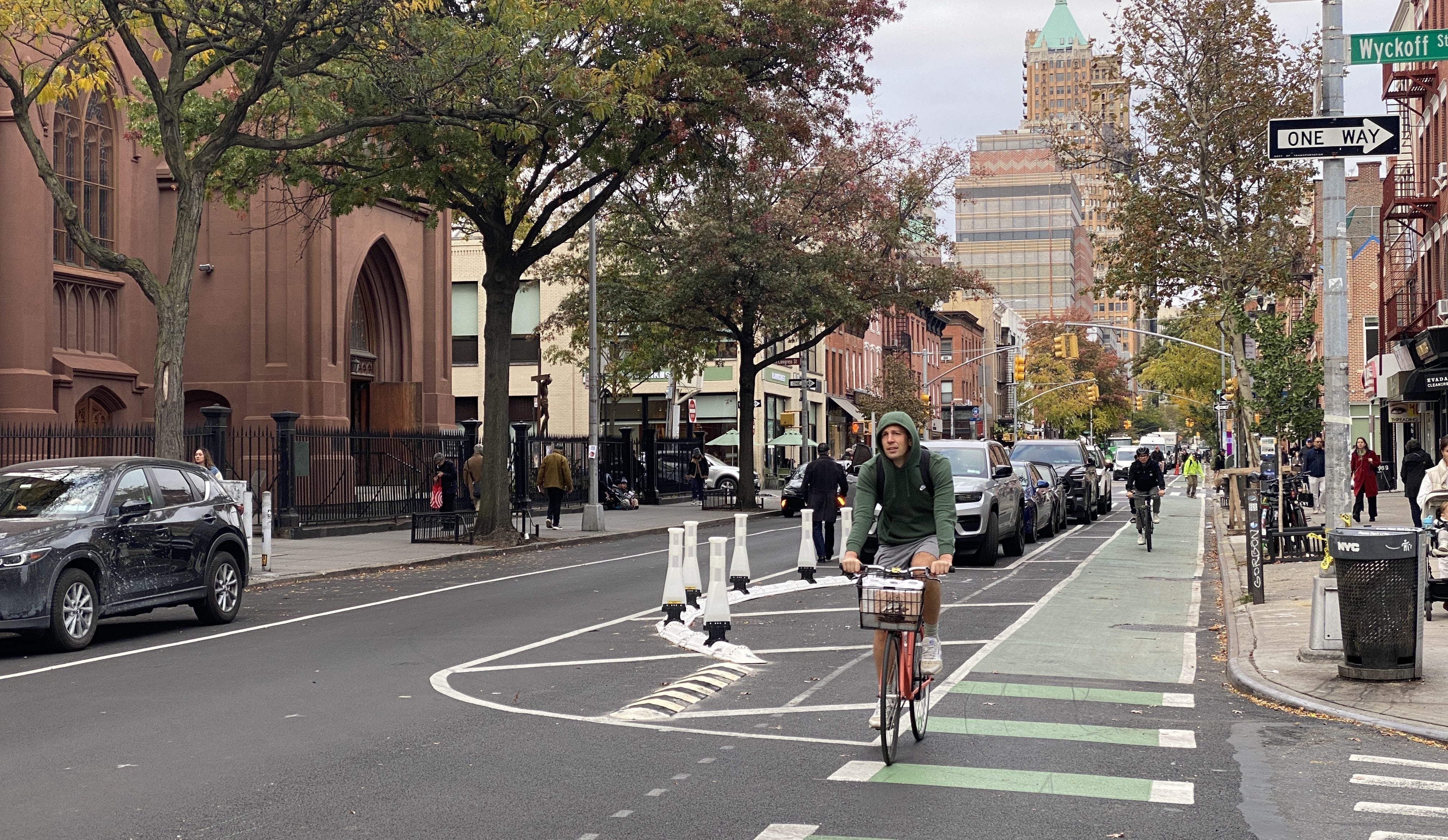
A Brooklyn judge has thrown out a lawsuit aiming to halt the Court Street bike lane project, ruling that opponents failed to provide sufficient evidence that the city’s transportation department acted improperly when redesigning the busy corridor.
In a decision released Thursday, Brooklyn Supreme Court Justice Inga M. O’Neale dismissed all claims brought by the Court Street Merchants Association, which had sued the city and the Department of Transportation (DOT) in an attempt to reverse the implementation of the new bike lane. The group alleged that the DOT’s actions were “arbitrary and capricious” and violated their Constitutional rights.
The DOT installed a parking-protected bike lane and removed a vehicle traffic lane along a 1.3-mile stretch of Court Street between Schermerhorn Street and Hamilton Avenue in fall 2025. According to court documents, the agency cited safety concerns as the primary driver behind the project.
DOT Director of Safety Projects Chris Brunson said the “primary motivation” for the redesign was the “disproportionately high number of deaths and injuries” reported on the roadway. Between 2020 and 2024, 155 people were injured and two killed in crashes along this portion of Court Street, according to DOT data. The agency identified fast, aggressive turns and double-parking as key contributors to a higher-than-average number of sideswipes and collisions.
The project aimed to address these issues by reducing double-parking, enhancing intersection safety, and creating “dedicated space” for cyclists and pedestrians, according to court filings.
In October 2025, as construction began, the Court Street Merchants Association filed suit through attorney Hartley Bernstein. The group argued that the DOT had failed to comply with regulations governing major transportation projects and had not used “rational standards and empirically demonstrable factors” in developing the redesign.
The suit also included claims that the bike lane would harm local businesses and infringe upon their rights under the Fifth and Fourteenth Amendments by favoring cyclists over other street users. Affidavits from several business owners described increased vehicle traffic and delivery difficulties since the redesign began.
Justice O’Neale rejected those arguments, writing that the DOT “has demonstrated that it had a rational basis” for the project and that the Merchants Association “failed to demonstrate the existence of factual issues” pertaining to the legality or safety of the redesign.
O’Neale noted that the alleged negative impact on businesses did not amount to actionable legal harm, writing that the project “did not constitute the type of wrongful conduct necessary to sustain such a claim.” She also held that the plaintiffs had failed to establish a valid equal protection claim under the U.S. Constitution.
Addressing the broader concerns raised by opponents of the lane, O’Neale stated, “Under these circumstances, petitioners’ recourse is to petition the City’s elected and appointed officials because questions relating to the best use of city streets implicate policy concerns that are beyond the authority of courts to address.”
With all claims dismissed, the court also denied the group’s request for injunctive relief, allowing the Court Street bike lane to remain in place.
Attorney Hartley Bernstein, who also represents groups opposing a bike lane project on 31st Street in Astoria, did not immediately respond to a request for comment Thursday.
New York City Department of Transportation Commissioner Mike Flynn, who took office just days before the ruling, welcomed the court's decision.
“The redesign of Court Street reflects a proven approach used across the city and around the world, one that has been shown to improve safety for everyone, whether they’re walking, biking, or driving, and to support local businesses,” Flynn said in a statement. “We appreciate the court’s ruling, which affirms the city’s ability to deliver street improvements that protect the people who live, work, shop, and take their children to school on Court Street.”
Flynn, in his first days as commissioner, also joined Mayor Zohran Mamdani in re-launching the redesign of McGuinness Boulevard in Greenpoint, signaling what he called a “new era for New York City and a new era for New York City DOT.”